Solar suits boats well: it is silent, has no fuel and keeps charging the house battery at anchor. Flexible panels are the usual choice afloat because a boat rarely has a flat, unshaded, unused surface. They go on biminis, dodgers, curved cabin tops and decks where a framed glass panel can't. The catch is that the sea is hard on them: salt, feet, flogging canvas and the shadow of the mast. Here is what to look for in 2026.
The short version
- If you have a hard top or an arch with free space, a rigid panel is still cheaper per watt and lasts longer. Flexible panels earn their place on canvas, curves and decks.
- Anywhere a foot may land, buy a panel the maker rates as walkable. Most silicon flexible panels are not.
- Shade from the mast, boom and rigging is the biggest loss on a sailboat. Plan for it in the wiring, not just in the panel choice.
- An IP68 junction box, sealed connectors and a sealed cable entry matter more at sea than an extra percent of efficiency.
Where flexible panels go on a boat
| Location | How it is usually mounted | Watch out for |
|---|---|---|
| Bimini or dodger canvas | Zippers, snaps or straps through the grommets, so the panel can come off | Canvas flex and windage; take panels off before a blow |
| Hard top | Adhesive or screws; rigid panels also fit here | Heat build-up if glued flat with no air gap |
| Curved cabin top or coachroof | Marine adhesive or VHB tape on a clean, smooth curve | Bend limit, hatches and handholds, foot traffic |
| Deck | Adhesive; walkable panels only | Point loads, non-skid, water pooling at the edges |
| Lifelines and rails | Purpose-made brackets or semi-rigid boards | Shading from sails, damage when docking |
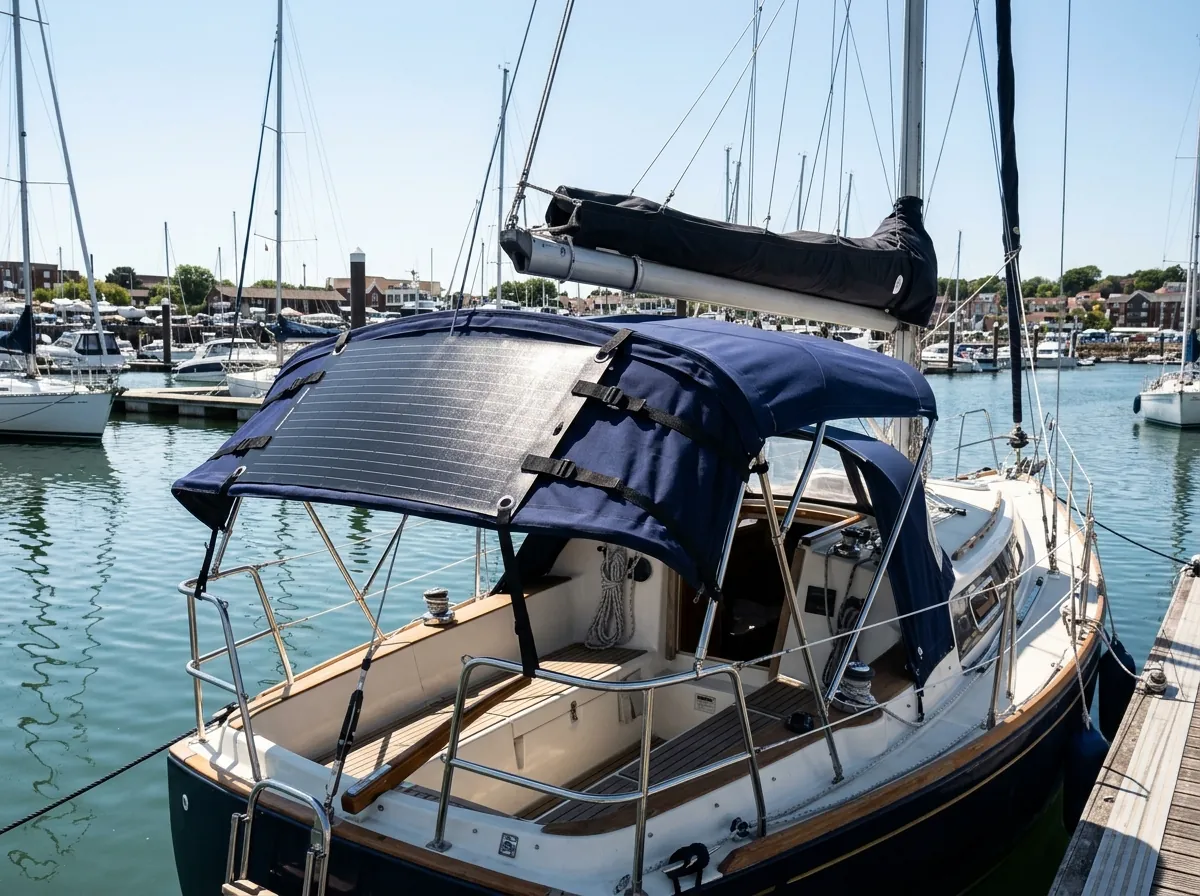
Grommets in the corners are what make canvas mounting work: straps or snaps go through them, and the panel can be removed in a minute. On solid surfaces most people bond the panel instead. Lensun, for example, recommends VHB tape or structural adhesives such as Sikaflex 552 for its flexible panels.
Walkable or not
The old advice for semi-flexible panels was "you can step on them, just don't make a habit of it". That was never great advice: pressure on a small area cracks silicon cells, and the cracks are invisible but cost output. Today a few makers sell panels that are designed for feet:
- Sol-Go markets its Next Generation panels as flexible, walkable and impact resistant, built on a copper base that it says resists micro-cracks and corrosion.
- Solbian, an Italian marine specialist, uses SunPower back-contact cells in its SP series and advertises higher resistance to impacts and foot traffic for its panels.
- BougeRV states that its CIGS Yuma panels are safe to walk on, because the thin-film cells are not brittle silicon wafers.
On the other side, Renogy's own FAQ advises against walking on its flexible panels. If the product page does not say "walkable", assume it isn't and keep it out of foot traffic.
Salt, water and heat
- Top layer. ETFE is the usual surface on quality flexible panels; Renogy's 2026 ShadowFlux uses TPO instead and says it resists moisture and delamination better. Avoid cheap PET-faced panels on a boat.
- Junction box and connectors. Look for an IP68 junction box and pre-attached, sealed MC4 connectors. Route the cable through a proper deck gland, not a blob of sealant.
- Hardware and wire. Stainless fasteners and tinned marine-grade wire, as for any other electrical work aboard.
- Heat. A panel bonded to a dark deck runs hot and loses output. Mounting over canvas or with a small gap helps.
Dealing with shade on a sailboat
On a sailboat something always casts a shadow: the mast, the boom, the radar, the sails themselves. In a standard panel, one shaded cell string can pull down the whole panel, and one shaded panel can pull down a series string. Three things help:
- Choose shade-tolerant panels. Makers now design for this. Renogy lists boat rigging among the shadows its Flex ShadowFlux is built for and claims up to 85% output under partial shade in its own lab test. Lensun claims over 20% more power than conventional cells under partial shade for its back-contact panels. BougeRV's CIGS Yuma uses multiple bypass diodes for the same reason.
- Wire in parallel or give each panel its own controller. Then a shadow on one panel does not drag down the others. Separate MPPT controllers per panel or per side of the boat are common on cruising boats.
- Don't mix panel types on one input. BougeRV warns against connecting CIGS and monocrystalline panels together because of the voltage difference.
Flexible marine solar panels worth a look in 2026
Specs below come from the makers' own pages, November 2026. We have not tested these panels ourselves.
| Panel | Cells | Why on a boat | Check before buying |
|---|---|---|---|
| Sol-Go Next Generation | Not stated on the product page | Sold as walkable and impact resistant; marine-focused brand | Exact model sizes and warranty with the dealer |
| Solbian SP series | SunPower back-contact | Marine specialist; high-efficiency cells; foot-traffic resistance | Voltage, size and warranty of the exact model with the dealer |
| BougeRV Yuma 200W CIGS | CIGS thin-film, 17% | 0.06 in thick, 5.95 lb, bends 360°, rated walkable; 10-year product and 25-year performance warranty | Length: 82.8 in for the 200W version |
| Lensun 240W Full Black | LONGi back-contact, 25.8% | Lots of power in a 46.8 × 38 in footprint; ETFE surface; maker calls it resistant to marine conditions | Warranty terms are not on the product page |
| Renogy Flex ShadowFlux 200W | N-type, up to 25% | Designed for partial shade, IP68, 7.72 lb | Not rated walkable; 44.1V open-circuit on the 200W version |
For a wider comparison of the same panels against rigid ones, see our guide to the best flexible solar panels. How CIGS differs from other thin-film types is covered in our thin film solar panels explainer.
How much solar does a boat need?
Start from daily use, not from panel size. A worked example, with our assumptions labeled:
- Assume the boat uses 900 Wh a day: a 12V compressor fridge, LED lights, instruments and charging phones. Your figure will differ; a battery monitor or the fridge's spec sheet will tell you.
- Use the common sizing rule of 5 peak sun hours and 75% system efficiency (the same assumptions BougeRV's sizing tool uses): 900 ÷ (5 × 0.75) = 240 W of panels.
- On a sailboat, add a margin for shade and lower winter sun. Somewhere around 300-400W is a sensible target for this example.
The panels only cover the daytime. At night everything runs from the house bank, so size the batteries for at least one night plus a cloudy day: 900 Wh is roughly 70 Ah at 12.8V. Many owners now pair flexible solar with lithium (LiFePO4) marine house batteries, which take charge quickly and weigh much less than lead-acid for the same usable capacity.
Running a van or trailer instead? The same math with RV-specific notes is in our guide to RV flexible solar panels.
FAQ
What is the best solar panel for a boat?
It depends on where it goes. On a hard top or arch with free space, a rigid panel is cheapest and lasts longest. On a bimini, dodger, curved cabin top or deck, a flexible panel is usually the only option; there, back-contact silicon panels give the most power per square foot, and CIGS or purpose-built walkable panels handle feet and shade best.
Can you walk on flexible marine solar panels?
Only on panels the maker rates for it. Sol-Go sells a walkable, impact-resistant line, Solbian advertises higher resistance to foot traffic, and BougeRV states its CIGS Yuma panels can be walked on. Renogy advises against walking on its flexible panels.
Can you put solar panels on a bimini top?
Yes. Light flexible panels are attached to the canvas with zippers, snaps or straps through the panel grommets, so they can come off for storms or winter storage. Keep the panel within the canvas edges and make sure the frame can take the extra windage.
Will a 400W solar panel run a fridge on a boat?
Usually, with a battery to cover nights and cloudy days. Using 5 peak sun hours and 75% system efficiency, 400W makes about 1,500 Wh a day, while a typical 12V compressor fridge needs a fraction of that. Mast and boom shadows can cut real output a lot, so check your own fridge's consumption and leave a margin.