Flexible panels look like the obvious pick for an RV: light, thin, no drilling. Plenty of owners love them, and plenty have pulled them off after a few summers and gone back to rigid. Both groups are right, depending on the roof. This page covers when flexible panels make sense on an RV or van, which 2026 models are worth considering, how to mount them so they last, and how much solar you actually need.
The short version
- Flexible makes sense on curved roofs (fiberglass caps, aluminum trailers, teardrops), on vans where height and weight matter, and when you can't or won't drill.
- On a flat roof with room, rigid panels on brackets run cooler, cost less per watt and have longer warranties.
- Most flexible panels in 2026 are 200W N-type or PERC silicon; CIGS thin-film is the option for tight curves.
- Size the system from daily use: about 1,500 Wh a day from 400W of panels in good sun.
Flexible or rigid panels on an RV?
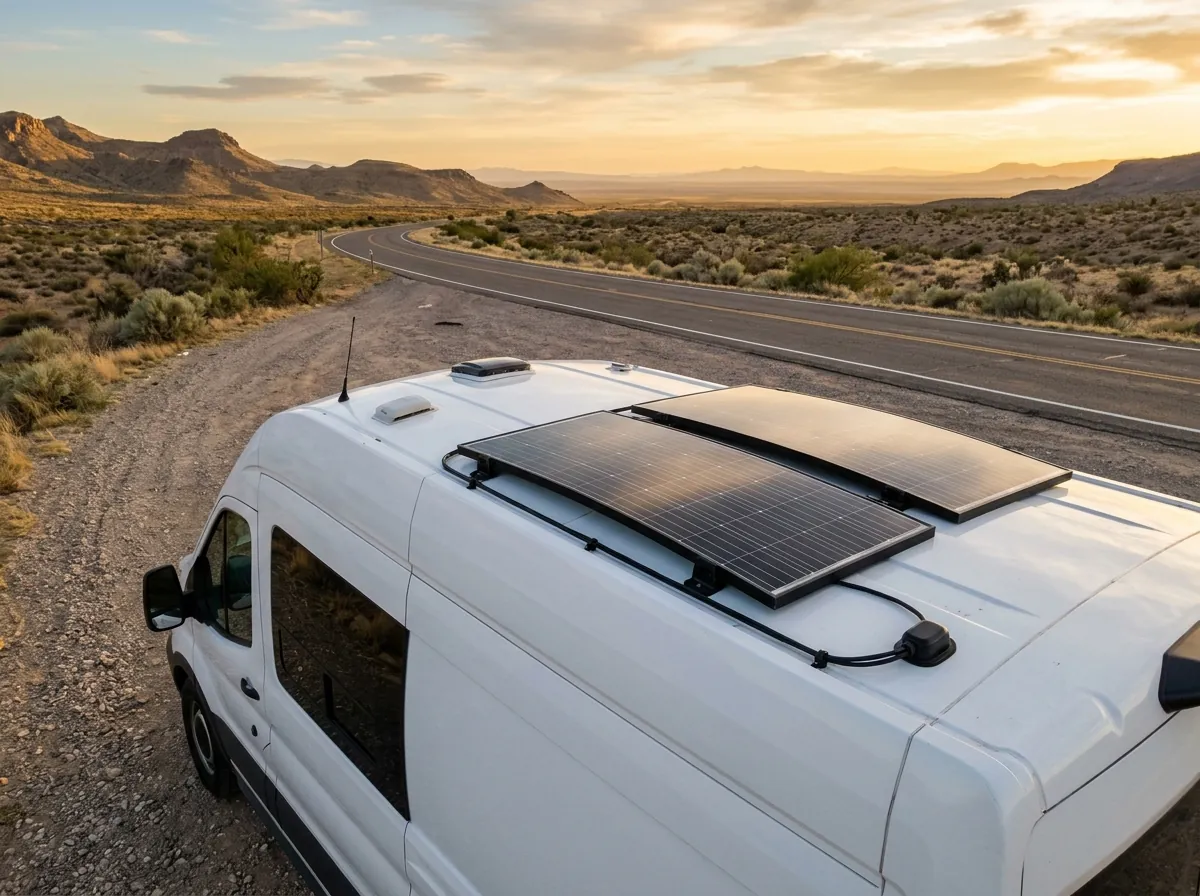
Rigid framed panels on raised mounts: the alternative to bonded flexible panels on a van roof.
Where flexible wins. A 200W flexible panel weighs roughly 6-9 lb and is about 0.1 inch thick. It follows a curved roof, adds almost no height for garages and drive-throughs, and goes on with tape or adhesive instead of brackets bolted through the roof.
Why some owners switch back. A panel glued flat to the roof has no air underneath, so it gets hot, loses output and ages faster. Warranties are also shorter on many flexible models: Rich Solar gives its MEGA 200 PRO FLEX a 1-year material and workmanship warranty, while its rigid MEGA panels carry 25-year output warranties. When a flexible panel fails, removing a fully bonded one is real work.
How to decide. If your roof is flat, has space between the vents and AC, and you don't mind brackets, go rigid. If it is curved, crowded or height-limited, go flexible and pick a model with a solid output warranty. For a full flexible vs rigid comparison table, see our guide to the best flexible solar panels.
Flexible solar panels for RVs and vans in 2026
Specs are from each maker's product page as of November 2026; we have not tested these panels ourselves. All five are around 200W except the Lensun.
| Panel | Cells | Voc | Weight | Size, in | Good for |
|---|---|---|---|---|---|
| BougeRV Arch Pro 200W | N-type TOPCon, 25% | 36.4V | 7.9 lb | 53 × 31 | Vans and trailers on 12V or 24V |
| Renogy Flex ShadowFlux 200W | N-type, up to 25% | 44.1V | 7.72 lb | 62.2 × 27.4 | Roofs crowded with vents, AC and racks |
| Rich Solar MEGA 200 PRO FLEX | PERC, up to 22.8% | 40.8V | 8.6 lb | 57.8 × 31.3 | 24V systems |
| BougeRV Yuma 200W CIGS | CIGS, 17% | 30.4V | 5.95 lb | 82.8 × 27.1 | Rounded trailers, tight curves |
| Lensun 240W Full Black | LONGi back-contact, 25.8% | 21.24V | 8.2 lb | 46.8 × 38 | Short, wide roofs; 12V systems |
BougeRV Arch Pro 200W
The all-rounder. N-type cells rated at 25%, a 270° bend, and BougeRV's statement that it is compatible with both 12V and 24V systems. It also has the best warranty of the silicon panels here: 25 years at 80% output and 5 years on materials. BougeRV claims up to 130W with a third of the panel shaded.
Renogy Flex ShadowFlux 200W
Built for the typical RV roof, where an AC shroud, vents or a ladder rack throw shadows for part of the day. Renogy cites up to 85% output under partial shade in its own lab test, using 30 bypass diodes. Mind the 44.1V open-circuit voltage when picking a controller, and note that it bends only along its length. Renogy's install tips for vehicles are useful: put protective film on paint before using adhesive, or mount the panel to a platform on a roof rack.
Rich Solar MEGA 200 PRO FLEX
A 24V-class PERC panel (Vmp 34.2V) with an IP68 rating and a "360° bendable" claim from the maker. It is a reasonable fit for 24V house systems, but the 1-year material and workmanship warranty is short, and it was backordered when we checked.
BougeRV Yuma 200W CIGS
The panel for shapes that silicon can't follow. It is 0.06 inches thick, bends 360° and carries a 10-year product and 25-year performance warranty. The trade-off is size: at 17% efficiency, the 200W version is 82.8 inches long. Our guide to thin film solar panels compares it with silicon spec by spec.
Lensun 240W Full Black
Back-contact cells at 25.8% put 240W into a nearly square 46.8 × 38 inch panel, which suits short roofs and roof tents. It is a 12V-class panel with an ETFE surface. It was on pre-order at $329 when we checked, and warranty terms are not on the product page.
How much solar does an RV need?
A quick way to size it, using the common assumptions of 5 peak sun hours and 75% system efficiency:
| Panels | Energy per day | About the same at 12.8V |
|---|---|---|
| 200W | 200 × 5 × 0.75 = 750 Wh | 59 Ah |
| 400W | 400 × 5 × 0.75 = 1,500 Wh | 117 Ah |
| 600W | 600 × 5 × 0.75 = 2,250 Wh | 176 Ah |
Add up what you use in a day (a 12V compressor fridge, lights, fans, water pump, laptops), pick the row that covers it with some margin, and expect less in winter and under trees. Panels glued flat to a hot roof will land at the low end.
Then size the battery for the night and a cloudy day or two. A 100Ah lithium battery at 12.8V holds about 1,280 Wh. A 200W panel delivering 150W needs about 8.5 hours of peak sun to fill it from empty (1,280 ÷ 150), so close to two good days. If you are choosing between lead-acid and lithium for the house bank, compare usable capacity and weight across RV deep-cycle batteries before deciding how many panels to buy.
Installing flexible panels on an RV roof
- Plan the layout around vents, the AC and antennas, and keep panels out of their shadows as much as you can.
- Check what the roof is made of. Fiberglass, aluminum, EPDM and TPO membranes each need a compatible adhesive; ask the adhesive or roof maker if unsure.
- Clean and dry the surface thoroughly. Tape and adhesives fail on chalky or dirty roofs.
- Bond or fasten the panel with VHB tape, a structural adhesive or screws through the grommets. Consider a thin platform or rails if you want an air gap or a removable install.
- Seal the cable entry with a proper roof gland, and add sealant along the leading edge so wind can't get under it at highway speed.
- Wire through a charge controller that accepts the panels' combined voltage, with a fuse or breaker between controller and battery.
Fitting panels on a boat instead? Shade and salt change the picture; see our guide to flexible marine solar panels.
FAQ
How do you attach flexible solar panels to an RV roof?
Most people use VHB tape or a structural adhesive on a clean, smooth roof, or screws through the panel grommets. Confirm the adhesive is compatible with your roof material, seal the cable entry, and secure the front edge so wind cannot lift it. If you would rather not bond to the roof, attach the panel to a thin platform or rail on a roof rack.
Will a 400W solar panel run a 12V fridge?
In most cases, yes, as long as a battery covers the night. With 5 peak sun hours and 75% system efficiency, 400W of panels makes about 1,500 Wh a day, which is more than a typical 12V compressor fridge uses. Check your fridge's rated daily consumption and allow for cloudy days and winter sun.
How long does a 200W solar panel take to charge a 12V 100Ah battery?
From empty, about 8.5 hours of peak sun for a 12.8V 100Ah lithium battery (1,280 Wh), assuming the panel delivers 75% of its rating, or 150W. At 5 peak sun hours a day that is close to two days. A half-empty battery takes about half as long.
Are flexible solar panels better than rigid for an RV?
Only on some roofs. Flexible panels win on curved fiberglass or aluminum roofs, where height or weight is limited, or when you want to avoid drilling. On a flat roof with space, rigid panels on brackets run cooler, cost less per watt and usually carry longer warranties.